
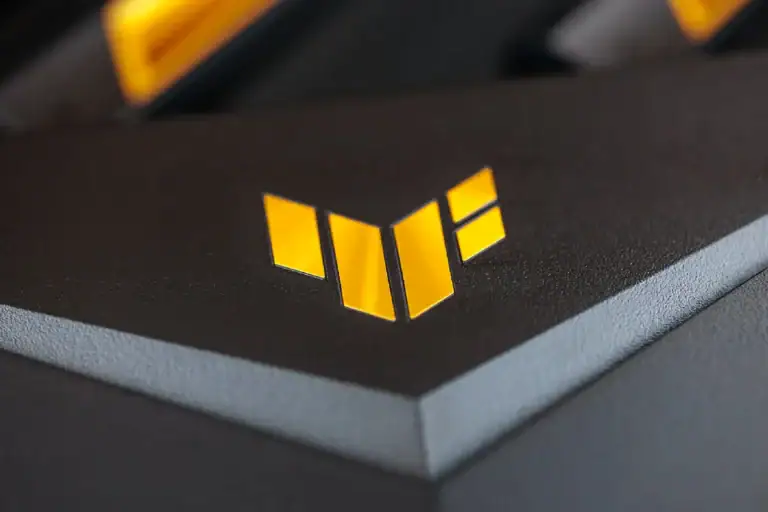
ASUS TUF - Industrial Silence and Sculpting Form: Product Photography of Networking Equipment
This wasn't an ordinary home router - it was an aggressive, low-profile block designed like a piece of military armor. We abandoned catalog white in favor of a controlled cut of light, extracting from the ASUS TUF the tension between raw function and engineered form.
- Visual
- 2024 Year
Case study
Problem
Standard consumer electronics photography replicates the error of a white, shadowless background or excessive smoothing, which turns aggressive, engineering-grade gaming hardware into a cheap, plastic toy. Flat lighting loses the edges, heat dissipation perforations, and the raw character of military-grade devices.
Solution
We treated the ASUS TUF router like a piece of armor, building a scene in an industrial silence vibe on a dark, textured surface. We used precisely controlled light with grids and honeycombs and focus stacking on RF optics, carving out sharp refractions of the body and preserving deep, untouched blacks.
Result
Frames were created that expose the power of the construction and uncompromising quality of hardware engineering, in which the form directly communicates cooling performance and signal stability. The material constitutes a model study of technical lighting for enterprise-class and gaming hardware products.
This wasn't an ordinary router. It was a solid block - low, aggressive, technical. An object designed like a piece of military hardware, not home electronics. And it was treated exactly like that in front of the lens.
Concept and Background: Industrial Silence
The assumption was simple: ruthlessly highlight the construction. We rejected catalog, soulless exhibition in favor of showing an authentic character - the tension between function and form. The ASUS TUF speaks the language of engineering: sharp angles, cooling perforations, massive antennas. The light had to cut through and sculpt this shape, not smooth it out. The background was kept in a dark, matte tone with a subtle surface structure that anchors the device in the frame, preventing it from floating in a digital vacuum.
Light Architecture
The construction was illuminated using three precise sources:
- Key light: A 60x90 cm softbox with a grid, positioned at about a 45° angle on the left, slightly from above - a controlled stream sculpting the mass and giving it weight.
- Rim light: A narrow strip with a grid placed at the rear on the right side - a delicate outline of the antenna contours and sharp casing edges.
- Spot accent: A discreet beam with a honeycomb grid directed at the TUF logo with minimal power - a subtle detail instead of an intrusive flash.
Blacks remained deep blacks. No overexposure, no cheap gloss. The equipment looks raw and solid.
Optics, Geometry, and Focus Stacking
The session was shot with a Canon EOS R8 camera on a tripod with a manual white balance matched to the lamp color temperature:
- Optics: RF 50 mm f/1.8 for general shots and RF 85 mm for isolating technical details.
- Parameters: ISO 100, shutter speed 1/160 s, aperture stopped down to f/8 - f/11 to achieve maximum optical sharpness.
- Focus stacking: For macro shots, focus stacking was applied, ensuring perfect legibility of the perforations, I/O ports, and plastic texture from the foreground to the background.
Controlled contrast, untouched shadows, and zero artificial color cooling. Technology shown as a physical, precisely crafted instrument.
Scope
- Development of a military, raw lighting concept with the elimination of plastic gloss
- Three-point flash lighting setupmodeling key light, contour rim light, and detail accent
- Precise product session from a tripod on a Canon EOS R8 camera (RF 50mm and RF 85mm optics)
- Application of the focus stacking technique to preserve microscopic sharpness of perforations and ports
- Post-production under the regime of preserving authentic blacks and the natural, physical texture of the material
- Frame optimization for e-commerce formats and high-tech portfolio presentations