
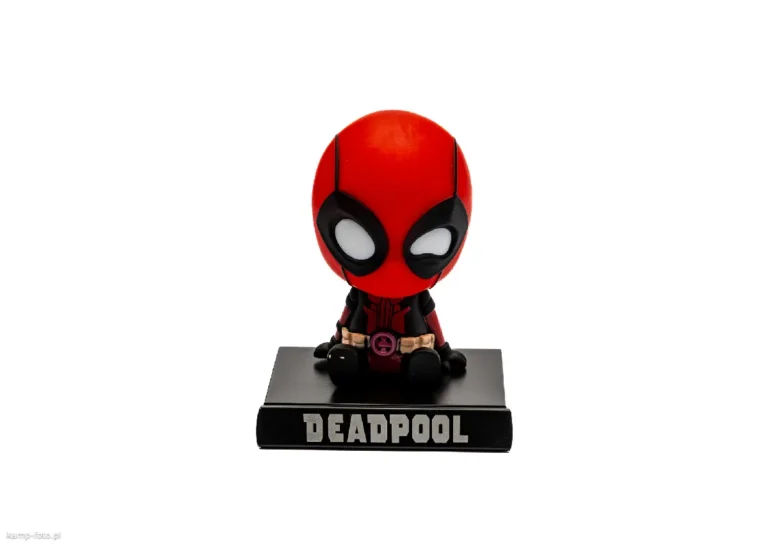
Deadpool - Small form, big character: Studio color control and collector's item portrait
Small form, big character. This wasn't just an ordinary photo of a figurine - it was a rigorous exercise in controlling aggressive color, symmetry, and studio light that turns a collectible object into a full-fledged, disciplined portrait.
- Visual
- 2024 Year
Case study
Problem
Photography of collectible figurines often falls into the "toy photo" trap-the aggressive red pigment easily gets blown out on the sensor, and attempts to brighten the background create unsightly haze (halo) and destroy the micro-texture of the details.
Solution
We built a balanced scene in soft studio lighting with a large main softbox, rim lighting, and a separate background snoot. We used a Canon EOS R8 camera on a tripod (f/9, ISO 100), achieving surgical sharpness of the shape and perfect white purity without losing the depth of black in the mask.
Result
A disciplined, symmetrical collector's portrait was created, exposing the character's identity, with a full reproduction of the material structure and uncompromising tonal purity. The material constitutes a benchmark of precision in reproducing chromatically difficult objects against a clean background.
Small form. Big character. This project was a precise exercise in color control, geometry, and proportion. The red of Deadpool's mask is uncompromising-in a digital frame, it easily clips color channels and loses microscopic detail. The priority was the absolute preservation of the material's texture and the sterile purity of the white background, without degrading the deep blacks in the costume and eye elements.
Frame Geometry and Hierarchy
We used a central framing-conscious symmetry, tranquility, and controlled optical distance. The figure mounted on the base with the logo was composed so that the typography forms a stable foundation without dominating the character itself. The whole is treated in terms of a studio portrait rather than a catalog packshot.
Soft Light Architecture
The lighting setup was subordinated to complete tonal separation:
- Key light: A large frontal softbox at a slight angle-precise modeling of the 3D form and natural shadow smoothing.
- Fill light: A rim light from the opposite side at minimal power-micro-contrast control and preservation of detail in deep shadows.
- Background lighting: A dedicated spot stream on the background-achieving absolute white without flares and the halo effect around the silhouette outline.
Equipment and Post-Production Rigor
The photo was captured with a Canon EOS R8 camera on a stable tripod, guaranteeing geometric repeatability. Exposure parameters: ISO 100, f/9 (maximum depth of field for the entire volume of the object) and a shutter speed of 1/160 s synchronized with the flash. Post-production was limited to white balance calibration and selective background cleaning. Aggressive clarity algorithms were consciously eliminated to protect the organic character of the collectible material.
This is not a toy photography. It is an orderly, thoughtful portrait of an object with a distinct visual identity.
Scope
- Development of the central portrait concept while maintaining the hierarchy of characters above the base
- Three-point soft studio lighting setup eliminating the halo effect on the edges
- Precise control of aggressive red saturation and surface texture without loss of detail
- Studio tripod session with a Canon EOS R8 camera stopped down to f/9
- White balance calibration and plane separation while preserving the deep blacks of the costume
- Discrete post-production preserving the organic character of the material without aggressive clarity